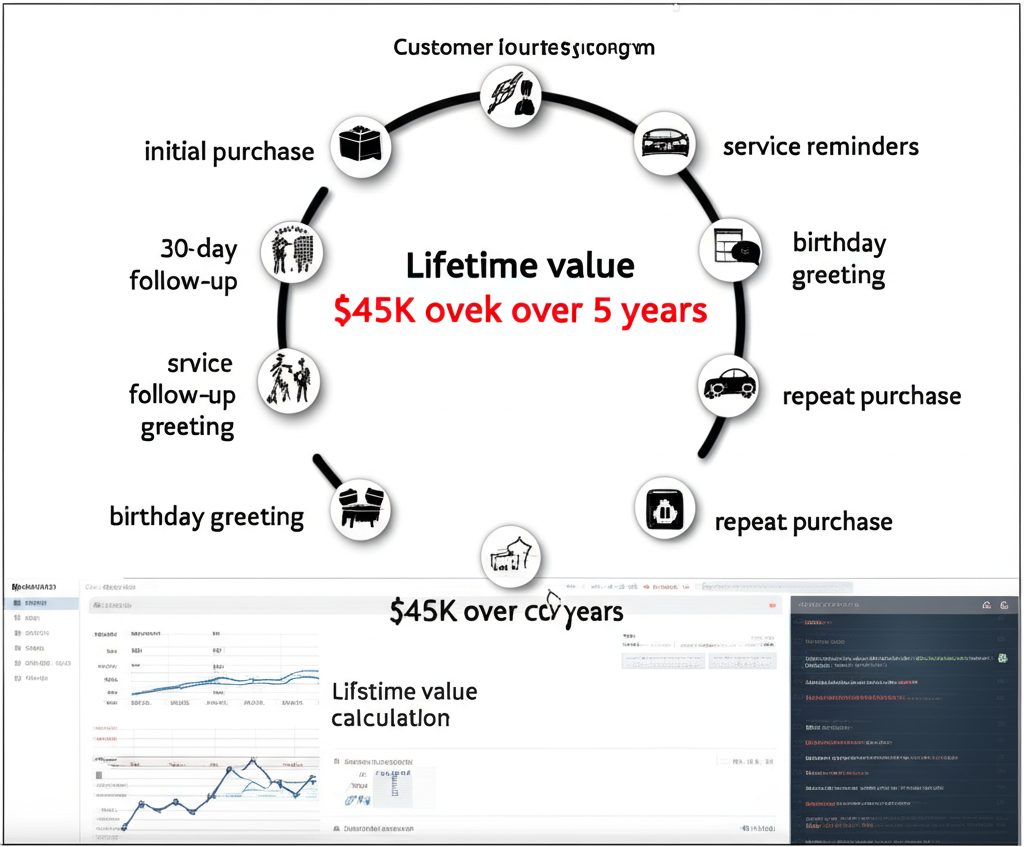
Customer Retention Strategies for Dealers
Service reminder campaigns, birthday greetings, equity alerts, loyalty rewards. Lifetime customer value strategies for independent dealers.
Most dealers spend 80% of their marketing budget chasing new customers and 20% retaining existing ones. This is backwards. Acquiring a new customer costs 5x more than retaining an existing one. Repeat customers convert at 60-70% (vs 15-25% for new leads), require less convincing, and generate referrals.
Yet the average independent dealer has a customer retention rate of just 10-15% - meaning only 1 in 10 customers returns for their next vehicle. This represents massive lost revenue: if you sell 200 vehicles/year and increase retention from 10% to 25%, that's 30 additional repeat sales with minimal acquisition cost.
Customer retention strategies are systematic processes to maintain relationships with past buyers, stay top-of-mind during their ownership cycle, and re-engage them when they're ready to purchase again. Effective retention programs boost repeat purchase rates by 25-50% and increase customer lifetime value by 2-3x.
This guide provides proven retention tactics: stay-in-touch campaigns, loyalty incentives, service reminders, re-engagement workflows, and CRM automation.
Why Retention Matters: The Economics
Cost Comparison: New Customer vs Repeat Customer
| Metric | New Customer | Repeat Customer | Advantage |
|---|---|---|---|
| Cost to Acquire | $200-$400 (ads, leads, marketing) | $40-$80 (email, SMS, retention campaigns) | 5x cheaper |
| Conversion Rate | 15-25% | 60-70% | 3x higher |
| Sales Cycle | 30-45 days (build trust from scratch) | 7-14 days (trust already established) | 3x faster |
| Average Deal Gross | $2,500 | $2,800 (less price negotiation) | 12% higher |
| Referral Rate | 10-15% | 30-40% | 3x more referrals |
Customer Lifetime Value (CLV) Example
Scenario: Independent dealer sells 200 vehicles/year. Average customer buys 1.2 vehicles over 5 years (20% retention rate).
- First purchase gross: $2,500
- Second purchase gross (repeat): $2,800 (less negotiation)
- Referrals generated: 0.4 referrals per repeat customer × $2,500 gross = $1,000
- Total CLV: $2,500 + $2,800 + $1,000 = $6,300
If you increase retention from 20% to 30%: 40 customers (20% of 200) → 60 customers (30% of 200) = 20 additional repeat sales × $2,800 gross = $56,000 additional profit/year with minimal marketing spend.
The 6-Phase Customer Retention Framework
Phase 1: Immediate Post-Sale (Days 1-30)
Goal: Ensure customer satisfaction, address buyer's remorse, and set foundation for long-term relationship.
Actions:
- Day 1 (Sale Day): Thank-you text from sales rep: "Congrats on your [Vehicle]! If you have any questions, call me anytime. - [Rep Name]"
- Day 3: Follow-up call: "Just checking in - how's the [Vehicle]? Any questions about the features or paperwork?"
- Day 7: Email: "Your [Vehicle] owner's manual + maintenance schedule" (PDF attachments)
- Day 14: Request review: "How's your experience so far? Would you mind leaving us a Google review? [Link]"
- Day 30: Satisfaction survey: "Rate your experience 1-10. What could we improve?"
CRM Automation: Trigger email/SMS sequence automatically when deal status changes to "Closed."
Phase 2: Ownership Support (Months 2-12)
Goal: Provide value-added services, build trust, and establish dealership as resource (not just transaction).
Actions:
- Month 2: Service reminder: "Your [Vehicle] is due for an oil change soon. We offer $39 oil change special for customers."
- Month 4: Seasonal tips email: "Winter is coming - check your tire tread, battery, antifreeze. Need help? We're here."
- Month 6: Check-in call: "How's the [Vehicle] treating you? Any issues we can help with?"
- Month 9: New arrival alert: "You bought a [Vehicle Type] - we just got 3 new [Similar Vehicles] in stock. Want to see them?"
- Month 12: Anniversary email: "It's been 1 year since you bought your [Vehicle]! As a thank-you, here's $100 off your next service."
Frequency: 1-2 touchpoints per month. Not selling - just staying helpful.
Phase 3: Long-Term Nurture (Years 2-3)
Goal: Maintain top-of-mind awareness during ownership cycle (customers typically keep vehicles 3-5 years).
Actions:
- Every 3 months: New inventory alert: "New [Vehicle Type] arrivals this week - prices starting at $15,000."
- Birthday: Personalized email: "Happy Birthday [Name]! Celebrate with $250 off your next vehicle or service."
- Seasonal promotions: "Tax refund season - trade in your [Vehicle] and upgrade to a newer model. Get $500 loyalty bonus."
- Referral requests: "Know anyone looking for a great deal? Refer a friend and get $250 when they buy."
Frequency: 1 touchpoint every 6-8 weeks. Stay present without being annoying.
Phase 4: Re-Engagement Window (Years 3-4)
Goal: Identify customers nearing end of ownership cycle and proactively initiate trade-in conversations.
Timing Triggers:
- 36 months after purchase: Average used car ownership cycle for independent dealers
- High mileage: Customer bought vehicle with 60K miles → Now likely 100K+ (major service costs approaching)
- Warranty expiration: Aftermarket warranty ending soon (fear of repair costs)
- Life events: Customer mentioned family growth, job change (new vehicle needs)
Actions:
- Month 36: Trade-in value email: "Curious what your [Vehicle] is worth today? Get instant appraisal. [Link]"
- Month 38: Upgrade pitch: "New [Vehicle Type] models just arrived - lower payments than you think. Trade-in your [Vehicle] for $X,XXX."
- Month 40: Personal call from original sales rep: "Hey [Name], it's been 3+ years - how's the [Vehicle]? Thinking about upgrading anytime soon?"
Frequency: Increase to 1-2 touchpoints per month during re-engagement window.
Phase 5: Active Shopping (Repeat Purchase)
Goal: Convert re-engaged customer into second sale with VIP treatment and loyalty incentives.
VIP Experience:
- Priority scheduling: "You're a repeat customer - I'll have [Vehicle] ready for test drive whenever you can come in (evenings, weekends, no problem)."
- Skip-the-line appraisal: "Bring your trade-in anytime - I'll appraise it same-day, no appointment needed."
- Loyalty discount: "$750 off as a thank-you for coming back. Plus waived doc fees ($300 savings)."
- Expedited financing: "I already have your info on file - we can get you approved in 15 minutes."
Incentive Stack Example:
- Loyalty credit: $750
- Waived doc fee: $300
- Trade-in bonus (vs market): $500 over ACV
- Total savings: $1,550 (customer perceives high value, cost to you is $1,050 after fee waiver)
Phase 6: Post-Repeat Sale (Referral Generation)
Goal: Turn repeat customers into brand advocates who generate referrals.
Actions:
- Day 1 (second sale): Thank-you gift: "$50 gas card as a thank-you for your loyalty."
- Day 7: Referral request: "You've bought 2 vehicles from us - know anyone else looking? Refer a friend and get $250 when they buy."
- Month 1: VIP status email: "You're now a VIP customer. Benefits: Priority service, exclusive inventory previews, 10% off all services."
Referral Tracking: Use CRM referral tracking codes. When referral leads convert, automatically email customer: "Your referral [Friend Name] just bought from us! Your $250 credit is ready."
Customer Retention Tactics by Channel
Email Campaigns (Primary Channel)
Best for: Long-form content, inventory showcases, educational resources
| Campaign Type | Frequency | Content Example |
|---|---|---|
| New Arrivals Digest | Weekly | "5 new [Vehicle Type] added this week" + photos, specs, pricing |
| Birthday/Anniversary | Triggered | "Happy Birthday [Name]! Celebrate with $250 loyalty credit." |
| Service Reminders | Every 3-6 months | "Your [Vehicle] is due for: Oil change, Tire rotation, Inspection" |
| Seasonal Promotions | Quarterly | "Spring Sale: $500 off all SUVs + 0% financing" |
| Educational Content | Monthly | "How to check your tire pressure" + video tutorial |
| Trade-In Value Alerts | At 24/36 months | "Your [Vehicle] is worth $X,XXX today. Get instant offer. [Link]" |
Email Best Practices:
- Personalize: Use customer's name, vehicle they bought, purchase date
- Mobile-optimize: 60% of emails opened on mobile - use single-column layout
- Clear CTA: One primary action per email ("Schedule Service", "View Inventory", "Get Trade-In Value")
- Unsubscribe option: Required by law. Better to lose unengaged subscribers than spam everyone.
SMS Campaigns (High Urgency)
Best for: Time-sensitive offers, appointment reminders, quick check-ins
- Service appointment reminder: "Hi [Name], your oil change is tomorrow at 10 AM. Reply CONFIRM or call to reschedule."
- Flash sale alert: "VIP ALERT: $1,000 off [Vehicle Type] this weekend only. Reply YES for details."
- Birthday message: "Happy Birthday [Name]! Stop by this week for a free car wash + $100 service credit. - [Dealership]"
- New arrival (matches preference): "[Name], we just got the [Vehicle] you wanted. First to see it? Call [Rep] at [Phone]."
SMS Rules:
- Obtain consent: Only send to customers who opted in (checkbox at sale, verbal permission)
- Identify sender: Start with dealership name: "Hi [Name], this is [Dealership]..."
- Timing: Send between 9 AM - 8 PM only (respect local time zones)
- Opt-out: Include "Reply STOP to unsubscribe" in first SMS and every 5th message
Direct Mail (High-Value Customers)
Best for: VIP customers, anniversary milestones, luxury vehicle buyers
- Handwritten thank-you note: Send within 7 days of sale (costs $3-$5, high perceived value)
- Anniversary card: "It's been 3 years since you bought your [Vehicle] - time to upgrade? Here's $1,000 loyalty credit."
- Exclusive preview invite: "You're invited: Private viewing of new [Vehicle Type] arrivals before public launch. RSVP by [Date]."
When to use: Customers who spent $30K+, repeat buyers (2+ purchases), referral champions (3+ referrals)
CRM Automation for Customer Retention
Automation Rule 1: Post-Sale Drip Campaign
- Trigger: Deal status = "Closed"
- Action: Enroll customer in 12-month post-sale email sequence (Day 1, 3, 7, 14, 30, then monthly)
- Content: Thank-you, satisfaction survey, service reminders, educational tips, review request
Automation Rule 2: Birthday/Anniversary Campaigns
- Trigger: Customer birthday (from CRM profile) OR purchase anniversary date
- Action: Send personalized email + SMS with loyalty incentive ($250 credit, free service, etc.)
- Follow-up: If no response after 7 days, send reminder: "Your birthday offer expires in 3 days!"
Automation Rule 3: Re-Engagement Campaign (36 Months)
- Trigger: 36 months since last vehicle purchase (average ownership cycle)
- Action: Send trade-in value email: "Curious what your [Vehicle] is worth? Get instant offer."
- Sequence: Week 1: Trade-in value email, Week 2: Upgrade pitch SMS, Week 3: Personal call from sales rep
- Exit condition: Customer schedules appointment OR opts out
Automation Rule 4: Referral Request (Repeat Buyers)
- Trigger: Customer completes second purchase (repeat buyer)
- Action: Send referral incentive email: "You've bought 2 vehicles - refer a friend and get $250 when they buy."
- Tracking: Generate unique referral code for customer. When referral converts, auto-send credit notification.
Measuring Customer Retention Success
| KPI | Formula | Benchmark |
|---|---|---|
| Customer Retention Rate | (Repeat Customers ÷ Total Customers) × 100 | 15-25% (good), 30%+ (excellent) |
| Repeat Purchase Rate | (Customers who bought 2+ times ÷ Total Customers) × 100 | 10-20% |
| Average Time to Repeat Purchase | Total days between purchases ÷ Repeat customers | 36-48 months (used cars) |
| Referral Rate | (Referrals generated ÷ Total customers) × 100 | 15-25% |
| Customer Lifetime Value (CLV) | (Avg gross × Purchases) + Referral value | $4,000-$8,000 |
| Email Open Rate (Retention Campaigns) | (Opens ÷ Emails sent) × 100 | 25-35% (higher than cold leads) |
Common Retention Mistakes to Avoid
1. Disappearing After the Sale
Mistake: "The sale is done - time to move on to the next customer."
Reality: Customers feel used. No relationship = no repeat business.
Fix: Follow up within 3 days of sale. Stay in touch monthly for first year.
2. Generic "Blast" Emails with No Personalization
Mistake: "Happy Holidays from [Dealership]! See our deals..." (sent to 5,000 customers)
Reality: Generic emails get deleted. Customers want relevant content.
Fix: Segment by purchase history: "You bought a [Vehicle Type] - here are 3 new [Similar Vehicles] in stock."
3. Only Contacting Customers When You Want to Sell
Mistake: "Hi [Name], want to trade in your car? We have great deals!"
Reality: Customers see through this. It feels transactional, not relational.
Fix: Provide value first (service tips, maintenance reminders, educational content), sell later.
Frequently Asked Questions
Why is customer retention important for car dealerships?
Retaining customers is 5x cheaper than acquiring new ones. Repeat customers convert at 60-70% (vs 15-25% for new leads), require less marketing spend, and generate referrals. A 5% increase in retention can boost profits by 25-95%.
How do I stay top-of-mind with past customers?
Use automated email/SMS campaigns: birthday/anniversary messages, new arrival alerts matching their preferences, service reminders (oil change, inspection), and seasonal promotions. Aim for 1-2 touchpoints per month without being spammy.
When should I start re-engaging past customers?
Begin re-engagement 24-36 months after purchase (average ownership cycle for used cars). Earlier for customers who expressed short-term ownership intent ('I need something reliable for 2 years until I can afford...').
What incentives work best for repeat customers?
Most effective: $500-$1,000 loyalty credit ('You bought from us before - here's $750 off your next vehicle'), VIP trade-in appraisal (skip the line, same-day offer), and waived fees (doc fee, dealer prep). Avoid generic discounts - personalize based on purchase history.
How do I track customer retention rate?
Retention Rate = (Repeat Customers ÷ Total Customers) × 100. For example, 50 repeat buyers out of 500 total customers over 3 years = 10% retention rate. Benchmark: 15-25% is good, 30%+ is excellent.
Can customer retention be automated?
Yes. CRMs automate birthday emails, service reminders, new arrival alerts based on past preferences, and re-engagement campaigns triggered by time since last purchase. However, high-value customers (spent $30K+, repeat buyers) deserve personal outreach from sales reps.
Turn one-time buyers into lifelong customers.
DealerOneView CRM includes automated retention campaigns (birthday emails, service reminders, re-engagement sequences), referral tracking, and customer lifetime value dashboards. Stop losing repeat sales to competitors.
See Retention Tools in Action →
Related Articles
Get More Insights Like This
Subscribe to our newsletter for the latest dealership tips and industry trends.