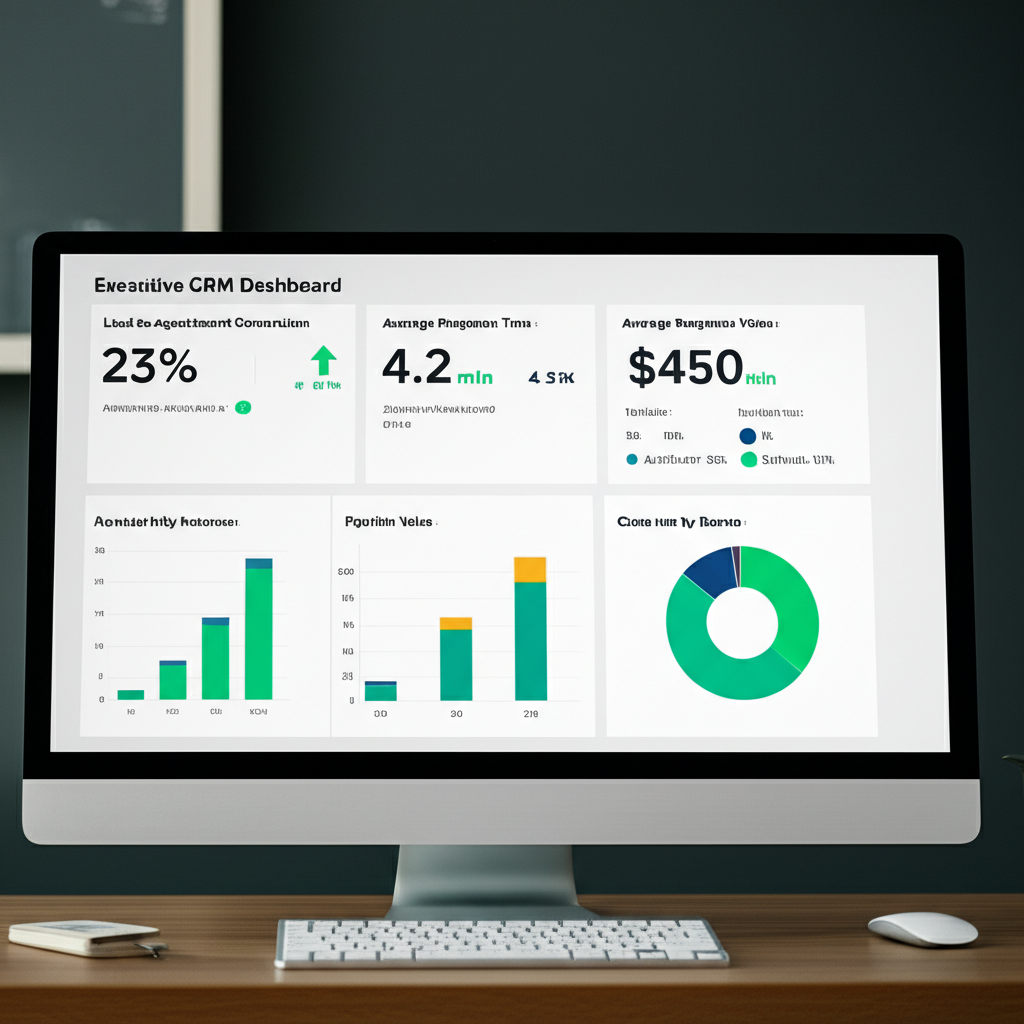
CRM Reporting KPIs: Conversion, Response Time, Pipeline
Essential CRM metrics for dealerships: lead-to-appointment conversion, average response time, pipeline value, close rate by source.
"You can't improve what you don't measure." This axiom is especially true for dealership CRM operations. Without clear metrics, you can't identify top performers, diagnose bottlenecks, or optimize marketing spend. Yet many dealers rely on gut feel rather than data-driven decisions.
CRM reporting KPIs (Key Performance Indicators) are quantifiable metrics that track lead management efficiency, sales performance, and customer engagement. Effective KPI dashboards answer critical questions: Which lead sources convert best? Are sales reps responding fast enough? Where do deals fall through? How much does a customer cost to acquire?
This guide covers the essential CRM KPIs every independent dealer should track, industry benchmarks, calculation formulas, and how to build actionable dashboards that drive better outcomes.
The 5 Critical CRM KPIs
1. Lead-to-Sale Conversion Rate
What it measures: Percentage of leads that result in closed deals.
Formula: (Total Deals Closed ÷ Total Leads Received) × 100
Example: 50 deals closed from 250 leads = 20% conversion rate
Industry Benchmark: 15-25% for independent used car dealers (franchise dealers average 10-15% due to higher third-party lead volume)
Why it matters: Conversion rate reveals lead quality and sales process effectiveness. Low conversion (<10%) indicates poor lead sources, weak follow-up, or inventory mismatch. High conversion (>30%) may indicate cherry-picking or insufficient lead volume.
How to improve:
- Track conversion by lead source - cut spend on low-converting channels (e.g., if Facebook ads convert at 5% but website inquiries convert at 30%, reallocate budget)
- Implement lead scoring to prioritize high-intent leads
- Train sales reps on objection handling and closing techniques
- Ensure inventory matches customer demand (if customers ask for $15K sedans but you stock $30K trucks, conversion suffers)
2. Average Response Time (Speed-to-Lead)
What it measures: Time elapsed between lead submission and first sales contact (phone call, email, SMS).
Formula: Total Response Time (minutes) ÷ Number of Leads
Example: 100 leads with total response time of 500 minutes = 5-minute average
Industry Benchmark: < 5 minutes (best practice), < 30 minutes (acceptable), > 1 hour (poor)
Why it matters: Speed-to-lead is the single most predictive metric for conversion. Research shows leads contacted within 5 minutes are 100x more likely to convert than those contacted after 30 minutes. Customers submit inquiries to 3-5 dealers simultaneously - first to respond often wins.
How to improve:
- Enable CRM mobile app push notifications for new leads
- Set up on-duty rep rotation (assign incoming leads to whoever is available now, not next day)
- Automate initial SMS if phone call fails: "Hi [Name], I just tried calling about the [Vehicle]. When can I reach you?"
- Track response time by sales rep - publicly display dashboard to create accountability
3. Pipeline Velocity (Days to Sale)
What it measures: Average number of days from initial lead inquiry to closed deal.
Formula: Total Days from Lead to Sale (all deals) ÷ Number of Deals Closed
Example: 50 deals with total 1,500 days from inquiry to close = 30-day average sales cycle
Industry Benchmark: 30-45 days (used cars), 60-90 days (new cars)
Why it matters: Faster sales cycles mean less time wasted on tire-kickers, lower floor plan interest costs, and higher inventory turnover. Long sales cycles (>60 days) indicate weak urgency-building, poor qualification, or inventory mismatch.
How to improve:
- Qualify leads upfront (budget, timeline, trade-in status) to avoid wasting time on long-term shoppers
- Create urgency: "This vehicle has 2 other interested buyers - can you come in today to lock it in?"
- Reduce friction: Offer online credit applications, e-signatures, home delivery
- Track by vehicle type - if trucks sell in 20 days but sedans take 60 days, adjust inventory mix
4. Cost Per Acquired Customer (CPAC)
What it measures: Total marketing/advertising spend divided by number of customers acquired.
Formula: Total Marketing Spend ÷ Total Deals Closed
Example: $10,000 monthly ad spend + 50 deals closed = $200 cost per acquired customer
Industry Benchmark: $150-$300 (third-party leads), $50-$150 (owned channels like website/referrals)
Why it matters: CPAC reveals marketing ROI. If you spend $500 to acquire a customer but gross profit per deal is $2,500, you're profitable. If CPAC is $1,500 on a $2,500 gross deal, margins are too thin.
How to improve:
- Track CPAC by lead source (Google Ads, Facebook, AutoTrader, organic) - cut underperformers
- Invest in owned channels: SEO, referral programs, repeat customer campaigns (lower CPAC than paid ads)
- Optimize ad targeting to reduce wasted spend on unqualified clicks
- Negotiate better rates with third-party lead providers (bulk discounts, performance-based pricing)
5. Customer Lifetime Value (CLV)
What it measures: Total revenue a customer generates over their relationship with your dealership (repeat purchases, service, referrals).
Formula: (Average Deal Gross Profit + Service Revenue + Referral Value) × Number of Repeat Purchases
Example: $2,500 gross profit per sale × 2 purchases over 5 years + $1,000 service revenue = $6,000 CLV
Industry Benchmark: $4,000-$8,000 (independent dealers), $10,000-$20,000 (franchise dealers with service departments)
Why it matters: High CLV justifies higher customer acquisition costs. If a customer is worth $6,000 lifetime, you can afford to spend $500 to acquire them. CLV also highlights importance of customer retention (repeat buyers are 5x cheaper to sell than new customers).
How to improve:
- Build referral program: Offer $250 credit for each referred buyer who purchases
- Stay top-of-mind: Send birthday emails, service reminders, new arrival alerts
- Create loyalty incentives: "You bought from us before - here's $500 off your next vehicle"
- Track repeat purchase rate (target: 20-30% of customers return within 3-5 years)
Supporting CRM KPIs
Beyond the core 5, these additional metrics provide deeper insights into CRM performance:
| KPI | Formula | Benchmark | Why It Matters |
|---|---|---|---|
| Lead Volume Trend | Month-over-month % change | +5-10% growth monthly | Declining lead volume = marketing issue or seasonality |
| Touchpoints Per Deal | Total contacts ÷ Deals closed | 8-12 touchpoints | Too few = weak follow-up. Too many = poor qualification. |
| Appointment Set Rate | (Appointments scheduled ÷ Leads) × 100 | 20-30% | Low rate = poor phone skills or unqualified leads |
| Show Rate | (Customers who showed ÷ Appointments) × 100 | 50-70% | Low show rate = poor qualification or no reminder follow-up |
| Test Drive to Sale | (Deals closed ÷ Test drives) × 100 | 40-60% | High conversion indicates strong closing skills |
| Lost Lead Reason | Categorize: Price, Inventory, Competitor, No Response | Vary by dealership | Identify recurring objections to address proactively |
| Email Open Rate | (Emails opened ÷ Emails sent) × 100 | 20-30% | Low rate = poor subject lines or unengaged list |
| SMS Response Rate | (Replies ÷ SMS sent) × 100 | 15-25% | Higher than email - best channel for time-sensitive messages |
CRM Dashboard Structure
Effective CRM dashboards organize metrics by audience and frequency. Here's a recommended structure:
Sales Manager Daily Dashboard
Purpose: Monitor real-time lead flow and sales team responsiveness
- New Leads Today: Count + trend vs yesterday/last week
- Leads Pending Contact: Flag any leads > 30 minutes old with no contact
- Hot Leads (Score 80+): List of high-priority leads requiring immediate action
- Appointments Today: Count + show rate % (how many actually showed up)
- Deals Closed Today: Count + total gross profit
- Response Time by Rep: Leaderboard (fastest to slowest) to create accountability
Sales Rep Personal Dashboard
Purpose: Give individual reps visibility into their performance vs goals
- My Conversion Rate: Personal % vs team average (e.g., "You: 18% | Team Average: 22%")
- My Pipeline Value: Total potential commission from active leads
- My Response Time: Average + compliance % (how often < 5 minutes)
- My Touchpoints Per Deal: Efficiency metric (lower = better qualification)
- My Active Leads: List sorted by lead score (prioritize follow-up)
- My Monthly Goal Progress: Deals closed vs quota (e.g., "12 / 15 deals - 80% of goal")
Owner/GM Weekly Dashboard
Purpose: Strategic overview of CRM health and trends
- Week-over-Week Trends: Leads (+/-%), Conversion Rate (+/-%), Deals Closed (+/-%)
- Conversion Rate by Source: Bar chart (Website: 25%, Facebook: 8%, AutoTrader: 12%, etc.)
- Average Sales Cycle: Days from inquiry to sale (trend over 12 weeks)
- Top Performing Reps: Leaderboard by conversion rate + deals closed
- Lost Lead Analysis: Pie chart (40% Price, 25% Inventory, 20% Competitor, 15% No Response)
- Cost Per Acquisition by Channel: Table comparing CPAC across all marketing channels
Owner/GM Monthly Dashboard
Purpose: Long-term strategic planning and ROI analysis
- Month-over-Month Lead Volume: 12-month trend line to identify seasonality
- Conversion Rate by Source (90-day): Identify which channels to scale/cut
- Customer Lifetime Value Trend: Track repeat purchase rate and average CLV
- Marketing ROI by Channel: Table showing Spend | Leads | Deals | CPAC | ROI %
- Sales Cycle by Vehicle Type: Identify fast-moving vs slow-moving inventory
- Team Performance Summary: Conversion rates, response times, deals closed (all reps)
How to Benchmark Your Performance
Use these industry benchmarks to identify strengths and weaknesses:
| KPI | Poor | Average | Excellent |
|---|---|---|---|
| Conversion Rate | < 10% | 15-20% | > 25% |
| Response Time | > 30 min | 5-30 min | < 5 min |
| Sales Cycle | > 60 days | 30-45 days | < 20 days |
| Cost Per Acquisition | > $400 | $200-$300 | < $150 |
| Appointment Set Rate | < 15% | 20-25% | > 30% |
| Show Rate | < 40% | 50-60% | > 70% |
| Test Drive to Sale | < 30% | 40-50% | > 60% |
| Touchpoints Per Deal | > 20 | 8-12 | < 8 |
Common CRM Reporting Mistakes
1. Vanity Metrics Over Actionable Metrics
Mistake: "We had 500 website visitors this month!" (without tracking how many became leads or deals)
Fix: Focus on conversion metrics (leads → appointments → sales), not just volume. 100 high-quality leads that convert at 25% beat 500 low-quality leads that convert at 5%.
2. Not Segmenting Data by Source
Mistake: "Our overall conversion rate is 15%." (but website inquiries convert at 30% while third-party leads convert at 5%)
Fix: Always segment KPIs by lead source, sales rep, vehicle type, and time period. Aggregate numbers hide critical insights.
3. Ignoring Leading Indicators
Mistake: Only tracking lagging indicators (deals closed, revenue) without monitoring leading indicators (lead volume, response time, appointment set rate).
Fix: Leading indicators predict future performance. If lead volume drops 30% this month, you'll see fewer deals next month. Track both.
4. No Accountability for Poor Performance
Mistake: "John's conversion rate is 8% (vs team average of 20%), but we haven't addressed it."
Fix: Use dashboards to create transparency. If a rep consistently underperforms, provide coaching or reassignment. Publicly display leaderboards (but private coaching for underperformers).
Frequently Asked Questions
What are the most important CRM KPIs for car dealerships?
The five critical CRM KPIs are: (1) Lead-to-sale conversion rate (target: 15-25%), (2) Average response time (target: < 5 minutes), (3) Lead pipeline velocity (days from inquiry to sale), (4) Cost per acquired customer, and (5) Customer lifetime value.
How do I calculate lead conversion rate?
Lead Conversion Rate = (Total Deals Closed ÷ Total Leads Received) × 100. For example, 50 deals closed from 250 leads = 20% conversion rate. Track separately by lead source to identify highest-quality channels.
What is a good response time for dealership leads?
Best practice is < 5 minutes for initial contact. Studies show leads contacted within 5 minutes are 100x more likely to convert than those contacted after 30 minutes. Track average response time and flag any rep exceeding 30 minutes.
How often should I review CRM reports?
Daily: Speed-to-lead and hot lead pipeline. Weekly: Conversion rates by source and sales rep performance. Monthly: Funnel analysis, cost per acquisition, and customer lifetime value trends.
What CRM reports should I share with sales reps?
Share individual performance dashboards showing: personal conversion rate vs team average, response time compliance, pipeline value, touchpoints per deal, and commission earned. Transparency drives accountability.
Can I benchmark my CRM metrics against industry averages?
Yes. Industry benchmarks: 15-25% conversion rate, < 10 min average response time, 8-12 touchpoints per sale, 30-45 days average sales cycle, $150-300 cost per lead (third-party). Compare quarterly to identify improvement opportunities.
Get real-time CRM analytics without manual spreadsheets.
DealerOneView CRM includes built-in dashboards for all key metrics: conversion rates by source, response time tracking, pipeline velocity, and sales rep leaderboards. Stop guessing - make data-driven decisions.
See CRM Analytics in Action →
Related Articles
Get More Insights Like This
Subscribe to our newsletter for the latest dealership tips and industry trends.